Private view: Wednesday 4 March 6.30 - 8.30pm
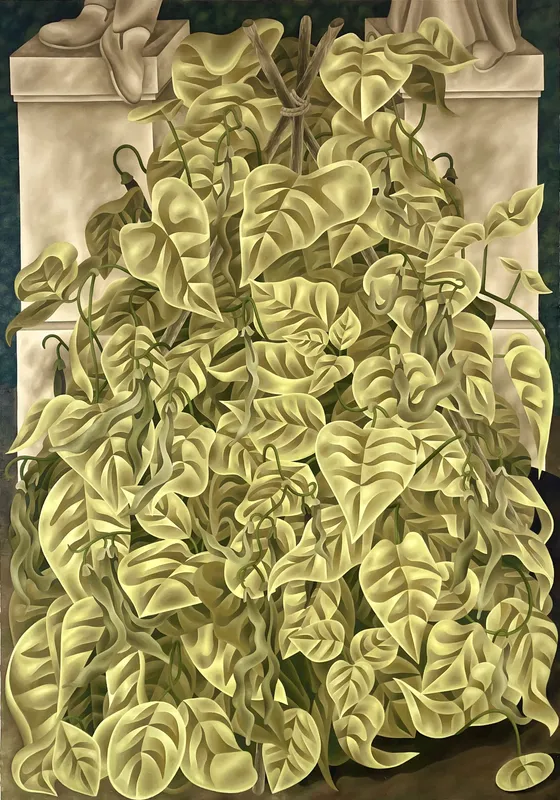
For her first solo exhibition at Cooke Latham, Lily Hargreaves combines a fascination with British stoicism and the arrogance inherent to the much satirised ‘stiff upper lip’ with a curiosity as to how these attributes manifest in our relationship to nature and the architecture of the English Garden.
In April of 1936 a school master, Kenneth Keast, and twenty-seven British schoolboys set out on a ten-day excursion to the Black Forest (Rhon, Germany). Five of them lost their lives in a disaster consequently known as ‘the English calamity’. The anomalies of the case remained dormant for many years with the official story being that the onset of terrible weather had tragically claimed the student’s lives. Until, at the beginning of the 21st century when an amateur historian who was researching the Hitler youth became interested in the case.
The picture that emerged was of a woefully underprepared group of boys, inappropriately dressed, with a virtually redundant map and a teacher who was warned of the dangers of the expedition by locals. Later, following the rescue of the survivors by the villagers of Hofsgrund, the Hitler youth swept in to claim solidarity with the remaining boys and any investigation into culpability was supressed in a propaganda push to promote a faux alliance between Germany and the UK.
The English Calamity underpins this new body of work by Hargreaves who views the episode as an extreme example of ‘keep calm and carry on’; the arrogance of Keast and his belief in his ability to overpower nature, sacrificing the lives of the boys in his care to preserve a façade of bravery and heroism. Likewise, his assurance of his superior knowledge over the local Germans seems indicative of Britain’s wider relationship with foreign nations, a fear of outsiders overshadowing British politics post-Brexit (renewed interest in the Calamity also came in 2016) and the rise of the right wing.
Hargreaves’s exhibition takes the English garden as an alternative stage upon which the ‘calamity’ is enacted. The language of mazes, obelisks, walls and statuary can be read as one of restraint, arrogance, confinement and prestige, a metaphor for Britain’s heritage and an interrogation of its past and present politics.
